

Where construction grows without water‑sensitive planning, water suffers. Rivers and streams degrade, aquifers are depleted, and the oceans are affected, compromising their health.
Over the past decade, our Smart Water dialogue platform has enabled us to analyse this land‑to‑sea complexity and has highlighted the decisive role that architecture, urban planning and the tourism sector play in balancing the water cycle.
Three lines of work have proved particularly revealing:
- Smart Water, Smart Cities, focused on the role of smart cities in water management.
- Smart Water, Smart Building, centred on architecture as water infrastructure.
- Smart Water, Smart Destinations, developed with tourism and hospitality
The conclusions emerging from these debate platforms form an ideas reservoir that drives awareness and mobilises initiatives across professional practice and corporate strategies. In this sense, the ocean is understood as an architectural territory and a laboratory for ecological transition solutions that deliver direct benefits to the most vulnerable coastal communities.
This emerging field requires, as Carlos Garriga, Director of the Foundation, often emphasises, stable alliances among all sectors working in water and sanitation, so that technological innovations reach those who need them most and, at the same time, act as a first line of defence for the ocean: “Social architecture and environmental architecture converge on the same objective: preserving the water cycle. Water justice demands that we protect not only human health, but also the health of the ocean, ensuring that the benefits reach everyone.”
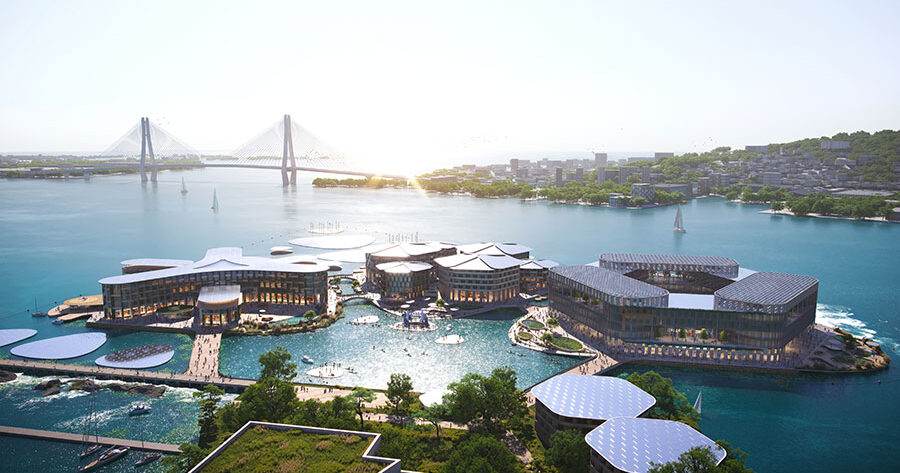
Sustainable architecture and tourism are becoming essential instruments for preserving the water cycle and strengthening the resilience of coastal communities. © OCEANIX Busan
Architecture, urban planning and tourism: stewards of water
In this process, we observe how architects and urban planners are assuming a central role: every building, every neighbourhood and every piece of urban infrastructure influences the quality of the water that reaches rivers, aquifers and oceans.
The tourism sector, meanwhile, offers a particularly significant and encouraging example. The new tourism model carries the responsibility of leading a form of development that serves as a benchmark for sustainability in how we inhabit the planet. Closely linked to architecture, urban planning, engineering and design, the hospitality sector has advanced rapidly towards a deeper understanding of sustainability and of the crucial role its facilities play in human development.
Coastal architecture: a discipline in full momentum
The convergence of architecture, urban planning, and tourism is shaping a professional ecosystem capable of influencing ocean health through the management of freshwater supply and consumption, as well as through sanitation’s decisive role.
We attended the recent AIA LATAM 2026 Water, Oceans and Architecture Congress, which confirmed the consolidation of a new professional field: coastal architecture, a discipline integrating oceanography, culture, engineering, ecology and design. A creative field taking a decisive step by addressing the water cycle in its entirety. Water and sanitation management require a transversal vision that connects inland territories with the coast, because water recognises no borders: it is a single system.
At the congress, Carlos Garriga presented compelling cases from our projects to demonstrate how water transforms communities, especially through education. He highlighted the water paradoxes that recur across many regions of the world, such as Chiapas, where territories with high rainfall have inhabitants who nevertheless lack access to water. His intervention transported the audience to the core of the planetary water cycle, the Amazon, through the documentary Amazonas: The Memory of Water and the key teaching drawn from Indigenous peoples: “our elders are living libraries.” Ancestral knowledge is indispensable for safeguarding the Earth’s water.
This approach opens a line of work that transcends construction and enters the realm of water governance, grounded in the knowledge of past generations and the active involvement of the communities that preserve it. Coastal architecture thus becomes an instrument capable of protecting ecosystems and strengthening the relationship between people and the ocean—the foundation of any sustainable solution.
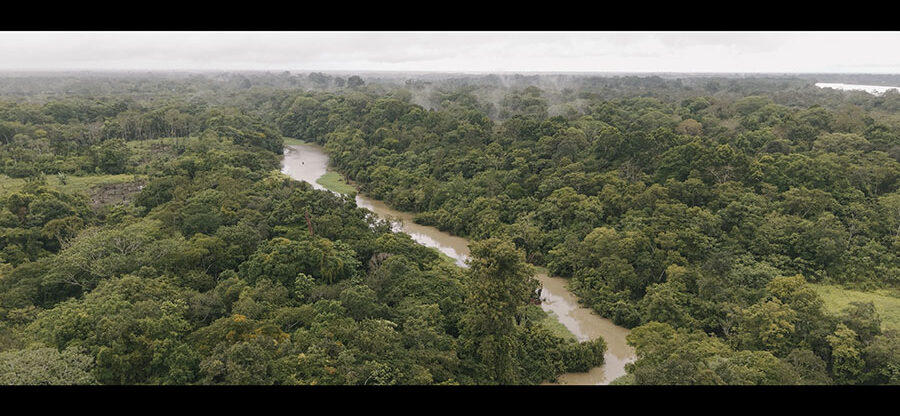
The intervention of Carlos Garriga transported the audience to the core of the planetary water cycle, the Amazon, through the documentary Amazonas: The Memory of Water and the key teaching drawn from Indigenous peoples.
Ocean health: the evidence is unequivocal
Solutions are urgent, and ideas are advancing rapidly. The AIA LATAM 2026 Congress confirmed this with a powerful synthesis: Jacques Rougerie presented the ocean as an architectural territory; the Zaha Hadid Architects team showed how coasts can anticipate marine dynamics; Iñaki Echeverría positioned wetlands as urban defence; and Julia Watson reminded us that ancestral knowledge remains a living technology. Four perspectives converging on one message: coastal architecture is no longer optional—it is a priority.
Science reinforces this urgency. On the recent World Oceans Day, the UN warned of accelerated deterioration: 90% of large fish species are depleted, and 50% of coral reefs have disappeared, while we continue to extract more than the ocean can replenish.
Each year, according to UNESCO, 36,000 km³ of freshwater reach the sea, a natural phase of the water cycle. But alongside this water travel the residues of human activity: those flowing through sewers, those discharged by treatment plants and desalination facilities, and those carried by industries and households. These terrestrial waters trigger processes as harmful as ocean acidification and warming.
From a climate‑mitigation perspective, the impact is profound. The seas produce at least 50% of the planet’s oxygen and absorb 25% of CO₂, equivalent to one million tonnes per hour.
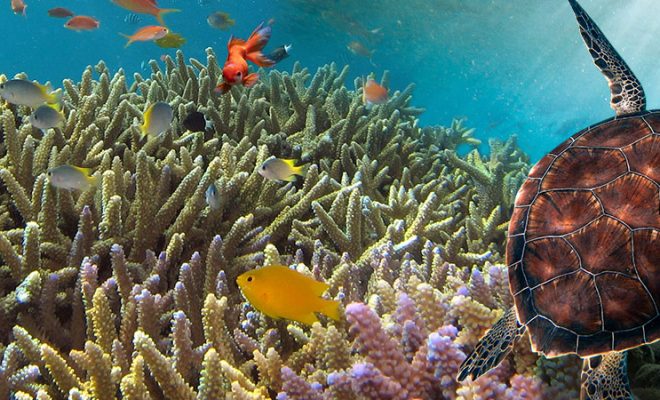
The ecological and socio‑economic magnitude is clear. Ninety‑eight per cent of the planet’s species inhabit the oceans, and more than one billion people depend on them as their main source of food. By 2030, the food security of 40 million families will depend directly on the sea.
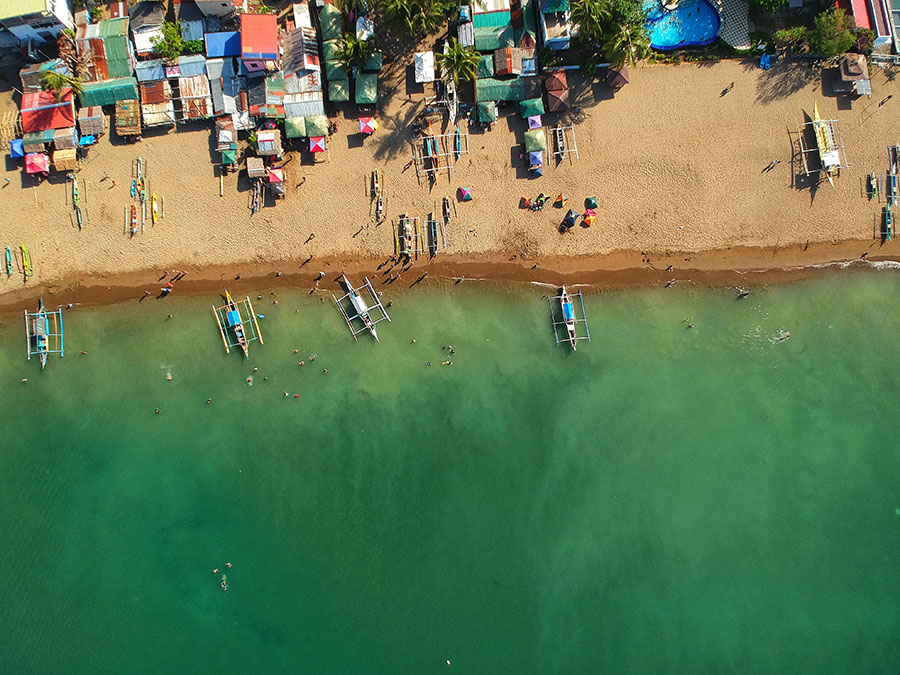
Ninety‑eight per cent of the planet’s species inhabit the oceans, and more than one billion people depend on them as their main source of food. By 2030, the food security of 40 million families will depend directly on the sea. © pexels-ferdie-cayanga
At the midpoint of the Ocean Decade
In this context, UNESCO’s Intergovernmental Oceanographic Commission (IOC) is driving the Ocean Decade, the largest global effort to promote scientific action to save the sea. The immediate horizon is decisive. Rio de Janeiro will host the 2027 Ocean Decade Conference, bringing together the global ocean community to assess progress and define new initiatives. It will be a key moment to consolidate commitments and place coastal architecture at the centre of action.
Coastal architecture integrates science, ecology, engineering, culture and design. It will play a prominent role as an instrument of water governance—not only by reducing impacts and protecting ecosystems, but also by transforming how communities relate to water.