
France, Belgium, Germany, Great Britain… The boreal summer is proving exceptional in countries that until recently were considered relatively distant from the most severe impacts of global warming. Longer droughts, more aggressive heatwaves, increasing forest fires and more frequent floods confirm the forecasts of the latest IPCC report (AR6), published in August 2021. Science anticipated that extreme events would intensify and shift towards latitudes where populations were not accustomed to living with them. That is exactly what has happened.

Climate change has manifested with particular intensity in areas and population groups previously far removed from its most severe impacts. © pexels-ben-collins
Has the public stopped trusting science?
This year, the phenomena have repeated themselves with greater intensity, subjecting communities in central and northern Europe to an adaptive checkmate previously unimaginable.
This new crisis, which once again confirms the IPCC’s forecasts, has coincided with the publication of the latest scientific data, which are compelling and come from peer‑reviewed articles (critically evaluated by experts who are not part of the editorial team): the climate crisis is advancing at an unprecedented speed in human history. CO₂ concentration reached 426 ppm in 2025, a level without precedent in 800,000 years of palaeoclimatic records. Throughout that entire period, the atmosphere never exceeded 300 ppm until the arrival of the twentieth century. The evidence is unequivocal and confirms that global warming is rapid, recent and human‑driven.
At the same time, this July, Nature published an article by Helen Pearson, science journalist and executive editor of the journal, posing an uncomfortable question: “Has the public stopped trusting science?”
The author analyses a troubling phenomenon: while the scientific evidence on global warming is stronger than ever, public attention to the climate crisis appears to be weakening. The text notes that, although the scientific community has reached an unprecedented consensus in calling more firmly for urgent action, this message does not translate into equivalent social mobilisation.
According to Pearson, several international indicators show that citizens recognise the problem but relegate it in favour of other threats perceived as more immediate. In surveys carried out in Europe and North America—it should be noted, before last July’s heatwaves—the proportion of people who place the climate among their top three concerns has fallen steadily over the past three years. In France and Germany, the climate loses ground to inflation, housing and security. In the United Kingdom, the percentage of citizens who follow climate news “very closely” drops significantly. In the United States, the most sensitised group—the so‑called alarmed—shrinks for the first time in a decade, while the segment that recognises the problem but does not prioritise it grows.
The paradox in Spain as well
In Spain, after the alarming drought of recent years, various surveys show a paradox very similar to that observed in other European and North American countries: intense concern about climate change decreases precisely when impacts become more visible and more frequent. The most recent data—corresponding to 2025 and, it should be noted, before the climate crisis of July 2026—confirm this trend.
The annual study Sustainable Consumption and Certified Products reveals significant figures. In 2019, two out of three people (67%) considered climate change a major problem and said they were very worried about it. In the latest measurement, this proportion stands at four out of ten (42%), a drop of 25 points in the most intense level of concern.
The decline is especially abrupt among young people. The 16 to 24 age group, which in 2019 was the most sensitised, now —in 2025— shows the sharpest fall:
- men drop from 68% to 27%,
- women from 74% to 35%.
It is an unexpected shift in the generation that will experience the most severe impacts of global warming.
However, studies agree that knowledge and concern have not disappeared. The Spanish climatologist Javier Martín‑Vide—with whom we shared a debate panel at the Roca Barcelona Gallery during last October’s WaLS Conference—agrees with the majority view among sociologists and social psychologists: climate concern is still present. Still, it has been overwhelmed by more pressing problems.
Among young Spaniards, housing, healthcare and employment occupy the foreground and push the climate into secondary positions. Across the population as a whole, wars, political instability and inflation reinforce this trend and saturate the emotional and media agenda. These are problems perceived as tangible and imminent and therefore capture public attention. The climate crisis, although recognised, is relegated in favour of vital urgencies that directly affect everyday life.
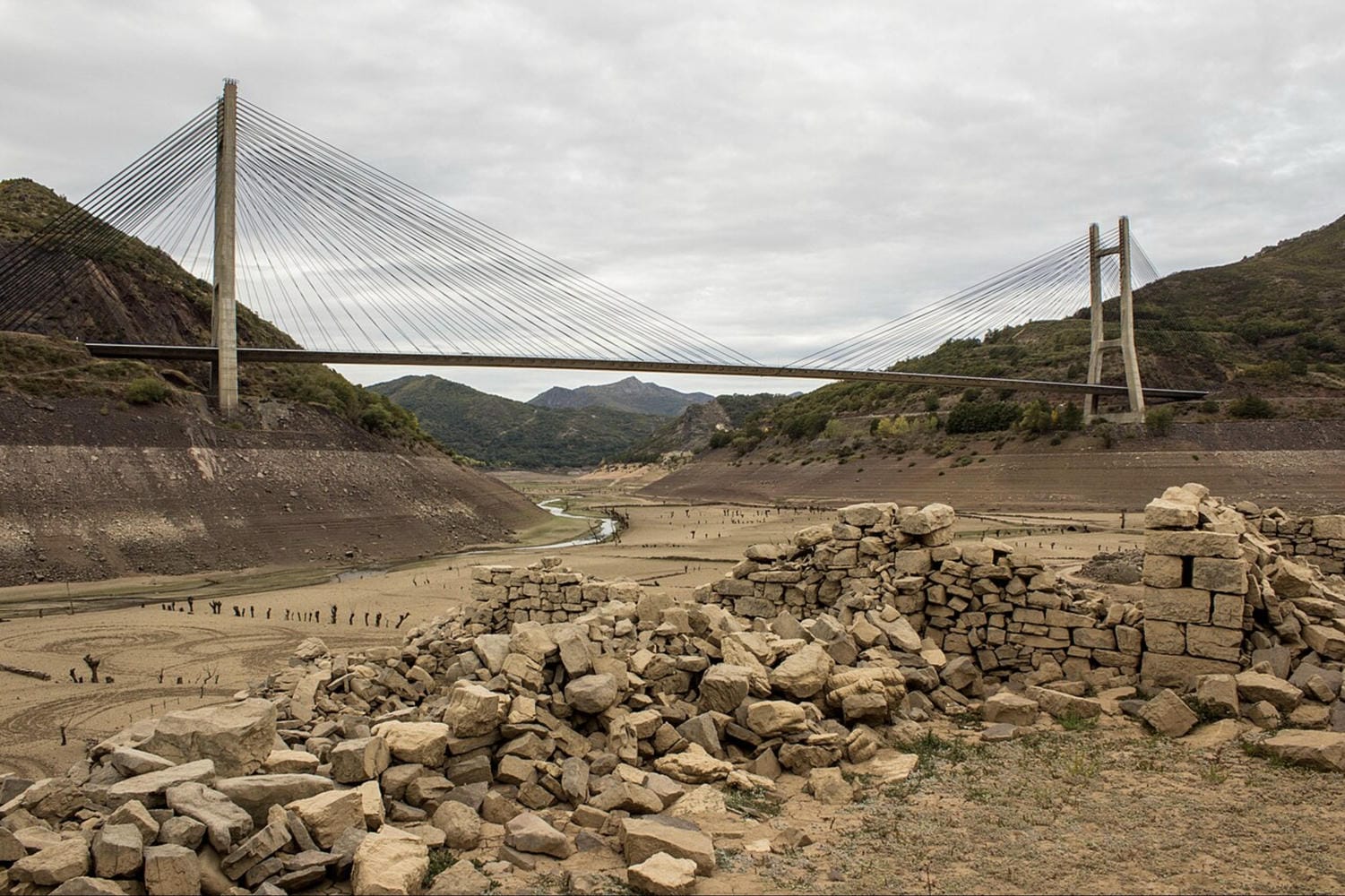
In Spain, after the alarming drought of recent years, various surveys show a paradox very similar to that observed in other European and North American countries: intense concern about climate change decreases.
Psychological factors
As we explained in 2021, there is consensus among psychologists and sociologists that the loss of public attention to the climate crisis does not stem from a lack of information or a rejection of science, but from a combination of social factors that shape how citizens process global threats. As early as 2013, researcher Pablo Ángel Meira documented how climate concern in Spain fell sharply during the economic crisis, displaced by problems perceived as more immediate. Later works, such as Psychological resistances in the perception of climate change, by Cristina Huertas and José Antonio Corraliza, have rigorously described the mechanisms that hinder awareness and explain why scientific evidence does not translate into social action.
The key problems are:
- Information saturation. The climate is perceived as constant noise. The repetition of alerts, reports and headlines generates a sense of overload that reduces sustained attention.
- Emotional disconnection. Scientific messages do not always manage to connect with everyday life. The climate crisis is perceived as abstract, distant or overly technical, making personal engagement difficult.
- Competition of priorities. The economy, housing and personal stability overshadow the climate crisis. When vital urgencies multiply, the climate loses space in the emotional and political hierarchy.
- Organised disinformation. Climate denial adapts, professionalises and exploits uncertainty. The spread of simplified, polarising or outright false messages erodes trust and diverts attention.
- “Climate fatigue”. The sense of powerlessness in the face of a global problem reduces willingness to act. When citizens feel their individual actions have little impact, motivation declines.
Towards climate communication that reconnects
Diagnoses from psychologists, sociologists and risk‑perception specialists converge on an essential point: the climate crisis does not stall due to lack of evidence, but due to lack of connection. Citizens recognise the problem, but fail to integrate it into their emotional and everyday hierarchy.
Scientific evidence needs narratives that restore the climate to its place in daily life, making it tangible, close and emotionally relevant. Summarising expert opinion, effective climate communication must integrate three keys:
- context, to situate the climate within the problems that already concern citizens;
- proximity, to show how it affects daily life without resorting to abstraction;
- operational hope, to replace powerlessness with capacity for action.
The challenge is to reconnect science with life, and evidence with collective action.

The climate crisis does not stall due to lack of evidence, but due to lack of connection. Citizens recognise the problem, but fail to integrate it into their emotional and everyday hierarchy.